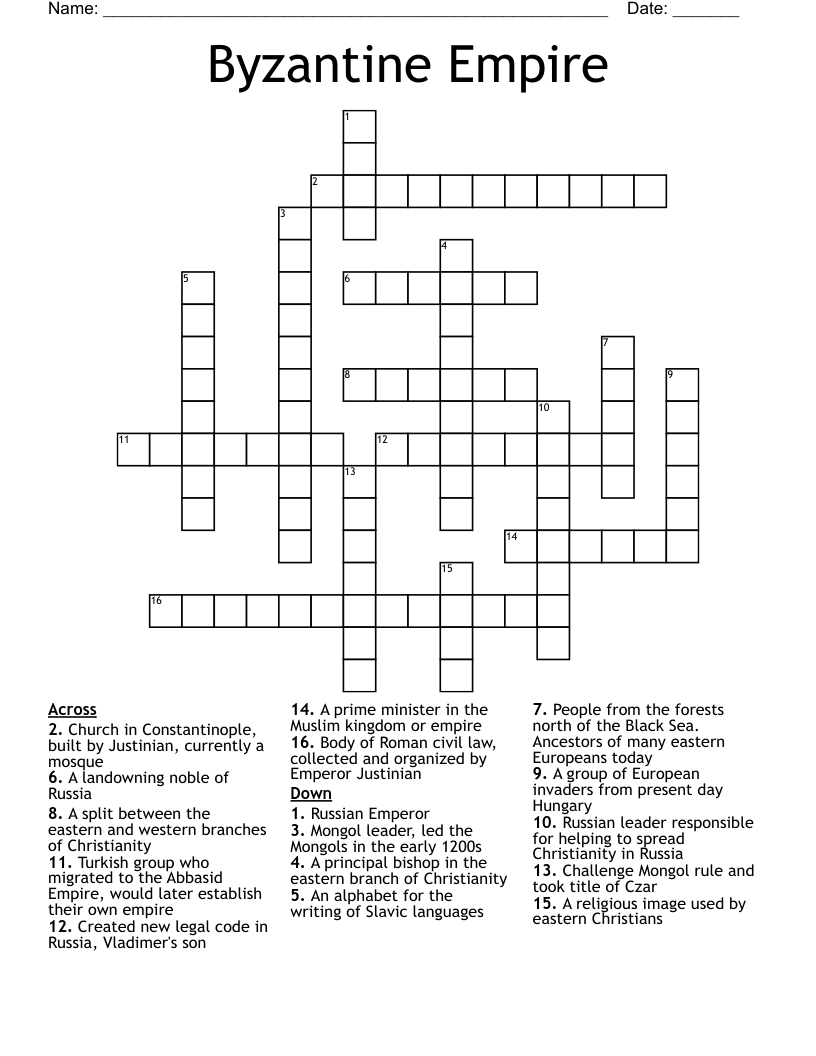
Mastering Byzantine Empire Crossword Clues and Answers
The Byzantine Empire, a fascinating and enduring civilization, often poses a unique challenge for crossword enthusiasts, especially when tackling clues in German. The phrase "Byzantinisches Reich Kreuzworträtsel" can send even seasoned solvers scrambling for answers. What might seem like a straightforward historical entity actually boasts a rich lexicon of alternative names and self-identifications, each with its place in the world of crosswords. This comprehensive guide will not only unveil the most common solutions but also dive into the historical nuances that make these answers so fitting, equipping you with the knowledge to conquer any Byzantine-related clue.
Unraveling the "Byzantinisches Reich" Challenge in Crosswords
At its heart, the Byzantine Empire was the continuation of the Roman Empire in the East. However, the term "Byzantine" itself was coined centuries later by Western historians, leading to a delightful complexity for crossword setters. When a clue demands an answer for "Byzantinisches Reich", it's rarely as simple as typing out the German name. Instead, you're often looking for its various historical designations, ranging from the short and snappy to the more formal and elongated.
Our research into common crossword solutions reveals a consistent set of answers, varying primarily by letter count. Understanding these, and the history behind them, is your key to mastering this particular crossword niche:
- RUM (3 Letters)
- OSTROM (6 Letters)
- ROMANIA (7 Letters)
- ROMANIIA (8 Letters)
- OSTROEMISCHESREICH (18 Letters)
Let's delve into each of these solutions, exploring their origins and why they frequently appear as answers for Byzantinisches Reich Kreuzworträtsel clues.
The Historical Tapestry Behind the Crossword Answers
To truly understand why these specific words are used, we must briefly journey through the empire's own perception and external labeling. The Byzantines never called themselves "Byzantine"; they were, first and foremost, Romans. Their empire was the Roman Empire, and their capital, Constantinople, was the "New Rome." This self-identification is crucial to many crossword solutions.
RUM (3 Letters): A Glimpse into its Enduring Legacy
The three-letter answer RUM might seem peculiar at first glance, but it carries profound historical weight. This term, derived from the Arabic and Turkish word for "Rome," was used by Muslim peoples in the medieval period to refer to the Byzantine Empire and its inhabitants. Later, following the Seljuk Turkish conquests of Anatolia, the Seljuks established the Sultanate of Rum, a state built upon former Byzantine territory, thus perpetuating the name. Its brevity makes it a perfect fit for those tight, three-letter slots in a crossword puzzle, providing a nod to the empire's impact and recognition across various cultures.
OSTROM (6 Letters): The Most Popular and Direct Answer
Undoubtedly the most common and often the "go-to" answer for Byzantinisches Reich Kreuzworträtsel clues, OSTROM translates directly to "East Rome" or "Eastern Rome." This term accurately reflects the empire's historical status as the Eastern Roman Empire, distinct from the Western Roman Empire that fell in 476 AD. It's concise, historically precise, and widely recognized, making it a favorite for crossword setters. If you encounter a six-letter slot for "Byzantinisches Reich," OSTROM should be your first thought.
ROMANIA (7 Letters) & ROMANIIA (8 Letters): The Byzantine Self-Identity
These two answers, ROMANIA and ROMANIIA, eloquently capture how the Byzantines viewed their own dominion. To them, their empire was simply "Romania," the land of the Romans. This term was widely used in medieval texts and by the Byzantines themselves to describe their state and its territories. The slight variation in spelling to ROMANIIA likely serves as an alternative for different letter counts, a common trick in crossword construction. Recognizing that the Byzantines considered themselves the true inheritors and continuators of Rome is key to unlocking these answers. It highlights the empire's deep-rooted connection to its Roman heritage, a fact often overlooked by casual observers but vital for crossword success.
OSTROEMISCHESREICH (18 Letters): The Full German Nomenclature
For those sprawling, eighteen-letter spaces, you might encounter OSTROEMISCHESREICH. This is the full, formal German translation for "Eastern Roman Empire." While less common due to its length, it is undeniably accurate. This answer is a testament to the comprehensive nature of some crossword puzzles, demanding the complete, descriptive name. When faced with a lengthy slot for Byzantinisches Reich, especially in a German crossword, don't shy away from considering the full, literal translation.
Strategic Approaches to "Byzantinisches Reich" Kreuzworträtsel
Solving crosswords, particularly those involving historical entities with multiple names, requires more than just memorization. Here are some actionable tips to help you master these clues:
The Power of Letter Count
Always, always start with the letter count. This is your most crucial hint. As demonstrated, the answers for Byzantinisches Reich vary significantly in length. Knowing you need a 3-letter word immediately points to RUM, while a 6-letter slot almost certainly indicates OSTROM. For more solutions and their letter counts, you might find specific helper pages invaluable, such as Byzantine Empire Crossword Answers: Find Every Solution.
Contextual Clues and Synonyms
Pay close attention to any additional words in the clue. Does it say "Short name for the Eastern Roman Empire?" That would strongly suggest RUM or perhaps OSTROM. Does it hint at self-identification or a name used by its people? That points to ROMANIA or ROMANIIA. Crossword setters often embed subtle hints to guide you toward the correct synonym or alternative name.
Embracing German Crossword Specifics
When dealing with Byzantinisches Reich Kreuzworträtsel, remember you're often in the realm of German crosswords. Be mindful of compound words (like OSTROEMISCHESREICH), umlauts (though not directly present in these answers, good to remember generally), and how foreign terms are integrated. German crosswords can sometimes be quite literal, which can be both a challenge and a help.
Leveraging External Resources
Don't be afraid to use a little help! Online crossword solvers and historical reference sites can be invaluable. If you're stuck, entering the clue and the known letter count into a specialized solver can quickly narrow down the options. Websites offering specific lists of answers, like Ostrom to Romania: Best Byzantine Empire Crossword Answers, are tailored to assist with these exact scenarios.
Conclusion
The Byzantine Empire, or Byzantinisches Reich, is a rich source of historical and linguistic puzzles, both for scholars and crossword enthusiasts. By understanding its various names – from the succinct RUM and popular OSTROM, to the self-identifying ROMANIA and its variant ROMANIIA, and finally the comprehensive OSTROEMISCHESREICH – you gain a powerful advantage. Armed with historical context, strategic thinking, and the awareness of common solutions, you're now well-equipped to master any crossword clue related to this magnificent empire. Happy solving!